4 Questions to Ask Before Buying “AI” — And What to Look for Under the Hood

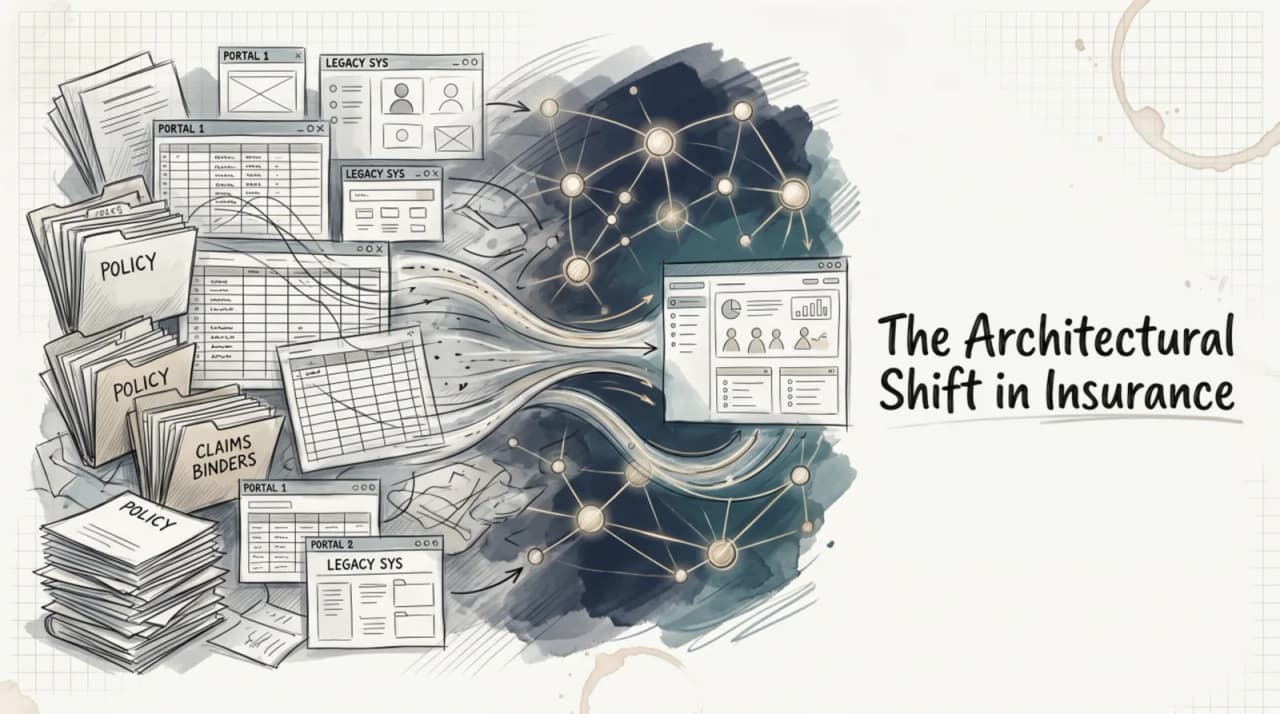
Renewal season. A client manager has six insurer portals open in one browser window, a claims spreadsheet in another, and a half-built quote comparison that the board needs by Thursday. An AI chatbot in yet another tab offers to "summarize" a policy document — but it cannot see the portals, the spreadsheet, or the presentation, and it has no memory of what was agreed with the client last quarter.
This is the daily reality for many insurance broking houses and intermediaries: talented people spending hours on data entry, re-keying, and chasing updates across disconnected tools.
The real opportunity of AI is not another chatbot. It is an operating system where underwriting, claims, customer service, and policy management share the same live data — so work flows cohesively across functions instead of fragmenting into a dozen disconnected tools.
The challenge is that most "AI for insurance" software today is a thin wrapper around a raw language model: a standalone chatbot bolted onto an old database, or one isolated feature that only sees its own corner of the business. It may generate impressive text, but it does not solve the underlying complexity of insurance data, regulatory compliance, or long-running commercial workflows.
To cut through the pitch, here are four questions you can ask any vendor — and yourself — before moving from legacy systems to AI-enabled infrastructure.
4 Questions Insurance Leaders Must Ask Vendors (and Themselves)
When transitioning your advisory or broking operations from legacy software to AI-enabled platforms, use this framework to audit internal readiness and evaluate third-party technology partners.
1. Is your solution a standalone chatbot, or a unified system that dynamically manages live insurance context?
Why it matters: A standalone AI chatbot cannot read multi-page commercial policy schedules or cross-reference dynamic insurer underwriting guidelines accurately, and an isolated feature only ever sees its own corner of the business. If a vendor promises "AI policy reading," ask how they handle context window limitations, document structuring, and whether that context is shared across the rest of your operations.
What to look for: The system must feature context engineering capability. It should pull live policy schedules, endorsement slips, claims registers, and insurer rating sheets directly into its runtime without requiring manual document extraction or data entry. Crucially, that context should be shared across underwriting, claims, servicing, and policy administration, so every module reasons over the same live data rather than each feature maintaining its own silo.
2. How does the software handle long-duration, multi-step workflows?
Why it matters: Renewing a complex corporate employee benefits policy or placing a multi-facility property and casualty program takes days or weeks. It involves multiple quote comparisons, insurer negotiation cycles, endorsement tracking, and board presentations. If an AI tool relies on basic in-context summarization, critical sub-limits or deductible nuances will fade during execution.
What to look for: Vendors must demonstrate a robust harness architecture. The platform should manage task states externally, maintaining absolute fidelity over data structures across long operational cycles rather than relying on conversation history.
3. Does the system require human triggers for every action, or can it execute autonomous background loops?
Why it matters: If your team has to log into a portal and click "Analyze" every time a new endorsement arrives or a claim status changes, you haven't automated your operations; you've merely replaced one manual data entry task with another.
What to look for: Ask if the software supports scheduled operational loops, background triaging, and event-driven automation. True modern infrastructure monitors broker mailboxes, client updates, and insurer portal feeds in the background, surfacing structured insights and completed drafts only when action is required. Full hands-off autonomy is still maturing across insurance, and human sign-off remains appropriate for most regulated actions today. What matters is whether the architecture is designed to extend into autonomous loops - auto-approval, self-healing reconciliations - as trust grows, rather than being permanently capped at manual triggers.
4. How does the platform isolate execution environments and manage state across multiple insurer interactions?
Why it matters: In commercial lines broking, an account executive might negotiate quotes with six different insurers simultaneously while applying specific policy modifications for different client subsidiaries. If the AI system blends these execution environments, rate leakages, confidentiality breaches, and data corruption occur.
What to look for: Look for architectures that support workspace isolation (worktrees), dedicated skills libraries, sub-agent verification routines, and transparent state tracking such as structured audit logs or progress registers.
Isolation is a cybersecurity requirement, not only an operational one. Insurance data is among the most sensitive a business holds, so ask how the platform enforces strict data segmentation and multi-tenant isolation, encrypts client and policy data in transit and at rest, applies role-based access controls, and threat-models its AI workflows against risks like prompt injection and data exfiltration. It should carry compliance-specific safeguards for the regimes you operate under, such as IRDAI, GDPR, or regional data-residency rules, so that automation never comes at the cost of confidentiality.
Before You Replace It: Solid Core, or Patchwork?
Before you evaluate a single vendor, run the same lens over what you already own. Not every legacy system needs to be ripped out. The deciding question is whether your current core is a solid foundation worth building on, or a patchwork of disconnected tools that will fight every future upgrade.
A solid core has a unified, well-structured data model, exposes clean APIs, and treats policy, claims, and client records as a single source of truth. That kind of system can be extended toward context, harness, and eventually loop engineering incrementally. A patchwork - a policy admin tool stitched to a separate CRM, a claims spreadsheet, and three insurer portals that do not share data - forces every AI capability to be rebuilt per silo and rarely reaches cohesive, cross-functional automation.
Ask yourself three things: Is our data unified enough that an AI layer could reason across underwriting, claims, servicing, and finance at once? Can we extend the system through APIs without vendor lock-in? Would each new AI capability compound on the last, or have to be rebuilt in isolation? If the honest answers point to a patchwork, the pragmatic move is often a cohesive AI-native platform that consolidates these functions, rather than layering more AI onto a foundation that cannot support it.
The AI Maturity Curve: From Prompts to Autonomous Loops
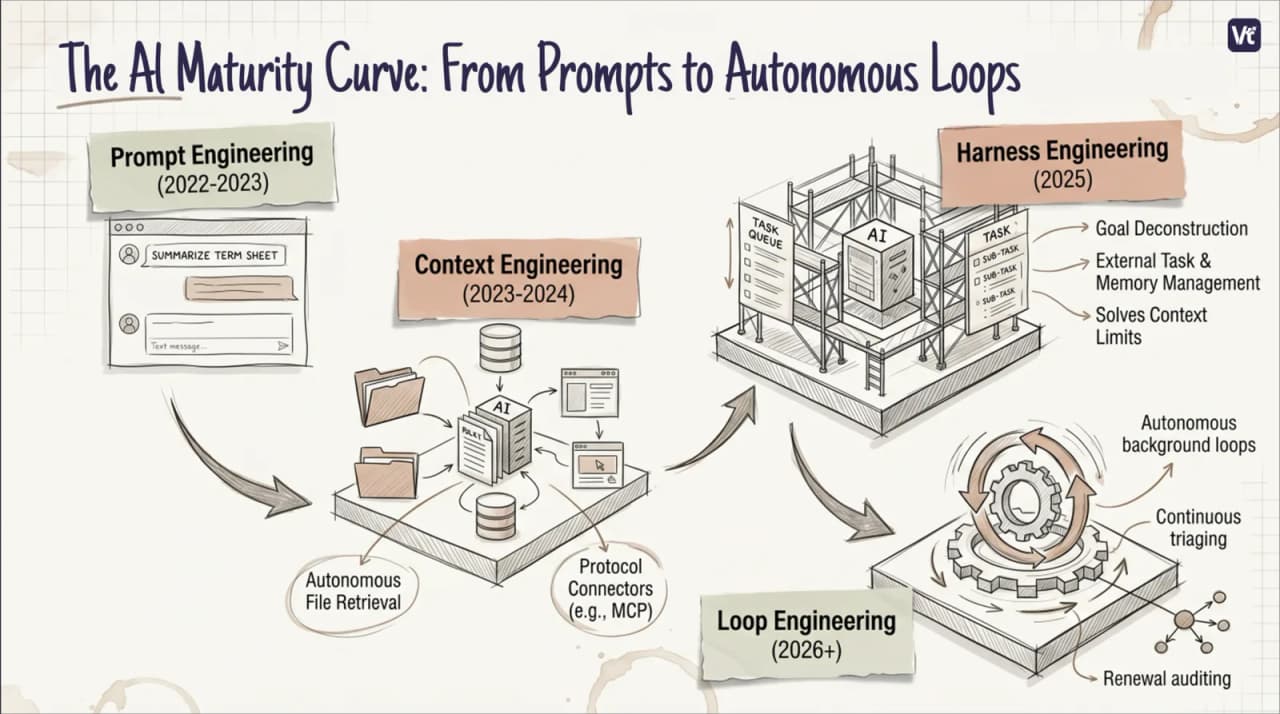
If you want to understand why those four questions work, it helps to see how AI engineering has evolved from basic prompting toward autonomous operational loops.
To evaluate any AI software vendor, you first need to understand the four distinct evolutionary stages of AI systems.
1. Prompt Engineering
The earliest stage of generative AI relied entirely on single-turn user prompts. You typed a question or prompt ("Summarize this policy terms sheet"), and the model responded using its static training data. While useful for simple text edits, prompt engineering has near-zero operational utility for insurance intermediaries because it lacks access to private client files, live policy databases, and dynamic insurer portals.
2. Context Engineering
As models gained larger context windows, system builders realized they could allow the AI to autonomously retrieve files, query external databases, and read live web pages using protocol connectors like Model Context Protocol (MCP). Instead of copy-pasting data into a chat window, the AI pulls the context it needs into its context window. In insurance, this allows an assistant to pull policy schedules, endorsements, and claims logs to answer specific account questions.
3. Harness Engineering
Context engineering hits a wall when handling complex tasks that take more than a few minutes. If an AI agent tries to execute a multi-step workflow inside a single context window, continuous summarization leaks critical details. Important exclusion clauses, sub-limits, or endorsement dates get lost over time.
Harness engineering solves this by placing an external system around the AI agent. The harness breaks complex goals into structured sub-tasks, managing memory, task queues, and context externally so the model stays accurate over long execution runtimes.
4. Loop Engineering
The emerging frontier is loop engineering. Up until harness engineering, every workflow still requires a human to trigger the action and evaluate the output - and today, in regulated insurance operations, that human oversight is a feature, not a limitation. Loop engineering introduces autonomous, self-guided execution loops that sit outside the harness.
In this model, instead of waiting for a broker or client manager to prompt it, a system could continually run background loops: monitoring policy renewal windows, auditing insurer quote discrepancies against RFQs, triaging claims status updates, and delegating verification to specialized sub-agents. Full autonomy of this kind is still developing across the industry. The architectural question is therefore not whether a platform ships fully autonomous loops today, but whether it is built so those loops - auto-approval workflows, self-healing data corrections - can be switched on safely and incrementally as trust and regulation allow.
The Building Blocks of an AI-Native Insurance Platform
If the maturity curve is the journey, these are the building blocks that have to be present in the engine.
To operate effectively at the loop engineering level, an insurance operating platform must integrate six core primitive capabilities:
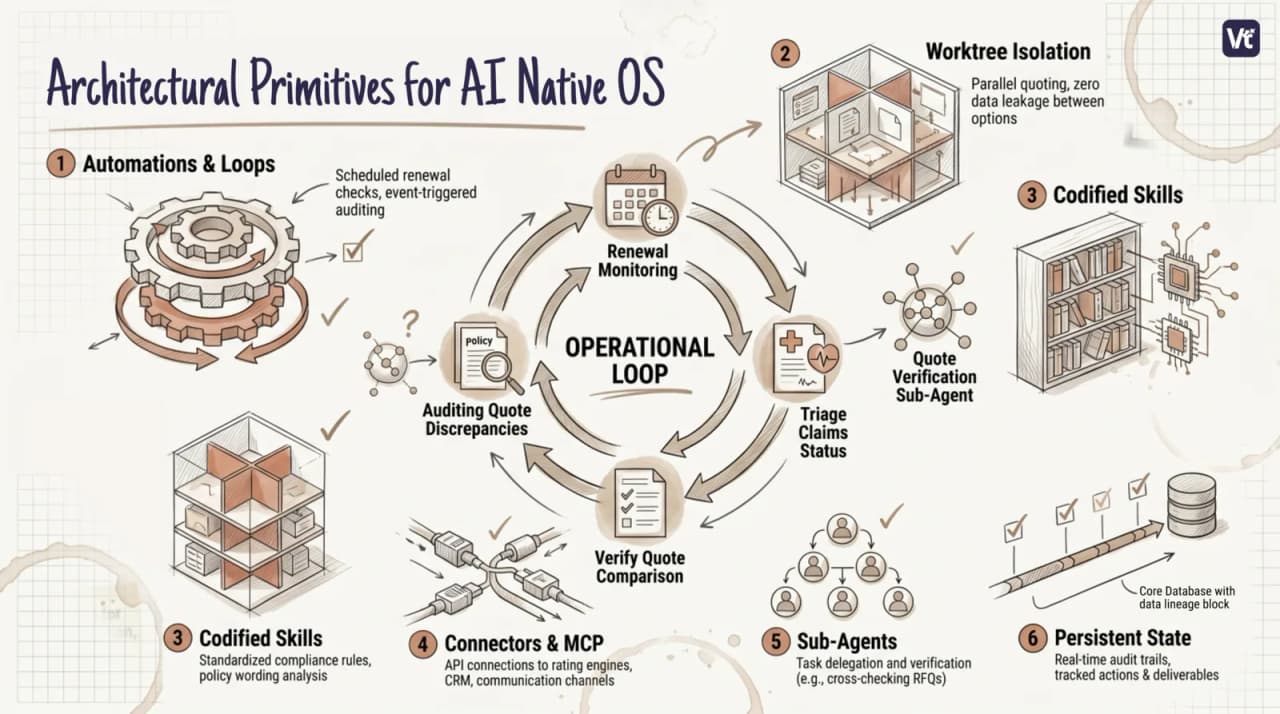
| Primitive | Role in Insurance Workflow | Practical Example |
| Automations & Loops | Scheduled and event-triggered execution | Automatically auditing policy renewal registers every morning and identifying expiring coverages 90 days out. |
| Worktree Isolation | Parallel execution with data segmentation | Drafting three distinct structured quote options across four competing insurers with strict tenant isolation and no data leakage between clients or options. |
| Codified Skills | Standardizing domain expertise | Encoding complex regional compliance rules, policy wordings analysis, or tax structures directly into reusable AI skill sets. |
| Connectors & MCP | Tool and data integration | Direct API and server connections to insurer rating engines, CRM databases, policy admin systems, and WhatsApp or email. |
| Sub-Agents | Task delegation and verification | Using a secondary verification sub-agent to cross-check drafted quote comparison terms against original RFQ specifications before sending to a client. |
| Persistent State | Real-time audit trails | Tracking completed actions, open deliverables, and client communications in structured logs or linear databases. |
How Vaatun Approached the AI Architecture Evolution
At Vaatun Technologies, we didn't build our platform by placing a superficial AI chat box over legacy broker database schemas. We recognized early that insurance intermediaries need deep, resilient infrastructure capable of moving through every stage of the AI maturity curve. Rather than shipping isolated AI features, we built one cohesive system in which underwriting, claims, customer service, and policy management run on shared data and shared context, so intelligence compounds across the whole operation instead of being trapped in separate tools.
From the beginning, our engineering strategy for our suite of products was designed to support the transition from basic context integration to full loop engineering:
- Vantage (Broker OS): Built to replace legacy management systems, Vantage combines dynamic context management with automated workflow harnesses, turning manual policy management, claims triaging, and invoicing into streamlined, data-driven operations.
- Advantage (Employee Benefits): Handles complex group medical and corporate schemes by deploying dedicated skills and sub-agents to digest claims data, manage endorsement updates, and generate automated renewal analytics.
- Quik (Distribution & Marketplace): Eliminates fragmented insurer portals and painful API integrations, serving as a unified execution layer for policy quotes, RFQs, and placement.
- VUEx (Underwriting Intelligence): Uses advanced context engineering and verification routines to standardise commercial policy comparison, quote generation, and risk analysis.
Whether helping commercial brokers in Australia and New Zealand adhere to rigorous compliance standards, enabling corporate advisors in the Netherlands and France to handle complex commercial property risk, supporting health and surety placement across Saudi Arabia, or scaling digital POSP distribution networks in India, Indonesia, and Thailand, Vaatun's architecture adapts continuously. Today the platform operates at the context and harness stages, with human oversight built into every regulated action and cybersecurity and data segmentation enforced at the core. As AI capabilities and regulation evolve toward self-guided loops, our architecture is designed to extend into autonomous workflows - auto-approval, self-healing reconciliations - progressively and safely, without disrupting your daily operations.
Key Implications for Insurance Operations Globally
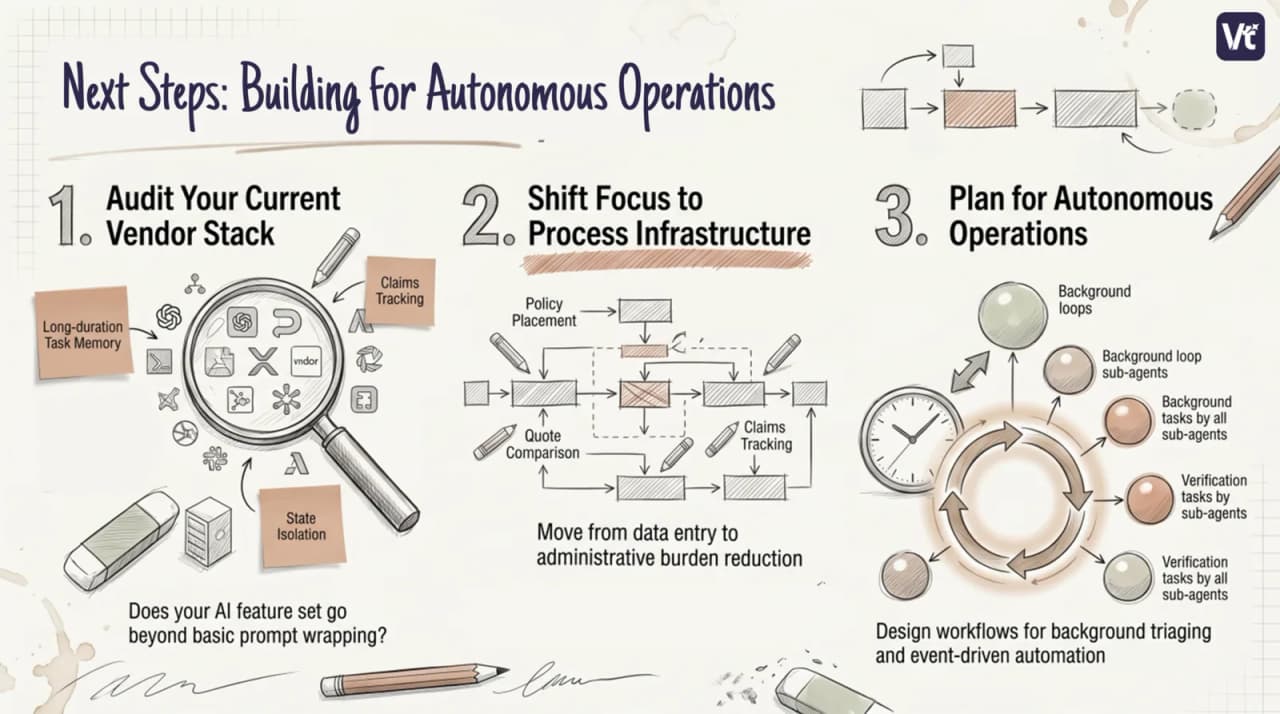
- Audit your current vendor stack: Ask your existing software provider whether their AI feature set goes beyond basic prompt wrapping. If they cannot explain how they manage long-duration task memory or state isolation, expect performance breakdown on complex accounts.
- Shift focus to process infrastructure: The value of AI in insurance is not generating conversational text; it is reducing the administrative burden of policy placement, endorsement processing, quote comparison, and claims tracking.
- Plan for extensible autonomy: Design your internal workflows with background loops in mind, even while you keep humans firmly in control today. Choose a foundation that can progressively take on routine updates, compliance checks, and quote requests as trust and regulation allow, so your client managers and advisors move toward focusing purely on strategic advice and client relationships.
Transitioning to AI-enabled insurance isn't about chasing the newest marketing terms. It's about deploying system architectures capable of handling the precise, data-heavy, multi-step realities of modern insurance distribution.
Vaatun builds AI-native operating infrastructure for insurance intermediaries, insurers, and distribution networks worldwide. vaibhav@vaatun.com
Experience Vaatun in Action
See how Vaatun's platform can streamline your insurance operations. Book a free demo with our team today.
Book a Free Demo