Dark Patterns in Insurance Broking: Why IRDAI's Undertaking Matters More Than It Seems

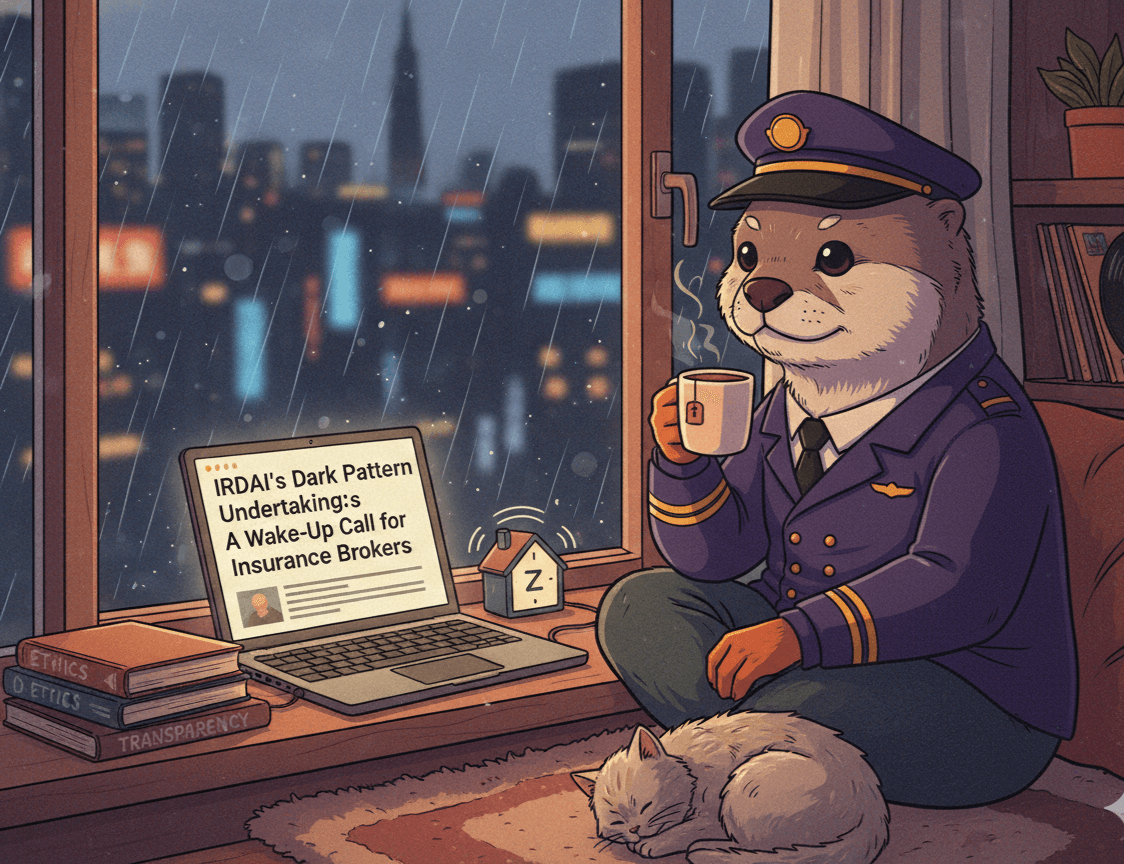
If the recent IRDAI dark pattern undertaking confused you a little, that is actually a good sign.
Because it means the industry is being pushed to look at something it has not always looked at closely enough: how insurance journeys are designed, not just what products are sold.
At first glance, the undertaking may look like one more compliance formality. It is not. It is a signal. It tells brokers that customer experience is no longer just a sales, servicing, or UI conversation. It is now also a governance, compliance, and trust conversation.
What is this undertaking really pointing at?
The undertaking requires licensed entities to carry out a self-assessment and confirm that specific dark patterns are not present in their operating ecosystem. The listed patterns include false urgency, basket sneaking, automatic addition of products, forced action, disguised advertisements, trick questions, SaaS billing traps, and even rogue malware.
That is a serious list.
Because dark patterns are not only about flashy e-commerce tricks. They are about design choices that distort decision-making. And that can happen very easily in insurance.
A quote comparison can be framed to push one option. An add-on can be nudged in without enough clarity. A customer can be made to share more data than is truly needed. A renewal message can create pressure instead of awareness. A cancellation or opt-out journey can be made more difficult than it should be.
None of this may look dramatic in isolation. But taken together, these patterns damage trust.
The undertaking covers false urgency, basket sneaking, forced action, disguised advertisements, trick questions, SaaS billing traps, and rogue malware - a comprehensive list that touches nearly every stage of the insurance customer journey.
IRDAI Dark Pattern Undertaking
Why this matters even more in insurance broking
Insurance is not an impulse purchase. A customer is not just buying a product. They are making a decision around financial protection, disclosure, exclusions, claims experience, and long-term service quality.
In many other industries, a poor digital experience is frustrating. In insurance, it can become unfair, misleading, or harmful. That is why this development should be welcomed by brokers, not feared. The best brokers already know that good distribution is not about squeezing a conversion. It is about guiding a decision responsibly.
This undertaking simply brings that principle into sharper focus.
Where dark patterns can quietly creep into broking workflows
Many teams think of dark patterns as a "website problem." That is too narrow.
In broking, they can appear across:
1. Quote comparison journeys
If a comparison screen over-highlights one insurer, downplays exclusions, or frames pricing without full context, it may influence more than inform.
2. Add-on and rider selection
If add-ons are pre-selected, bundled unclearly, or shown in a way that makes rejection awkward, the customer's choice is being steered.
3. Proposal and payment flows
If the journey hides fees, introduces information late, or uses urgency language that is not genuinely warranted, trust starts eroding fast.
4. Consent and data collection
If customers are pushed to share Aadhaar, app permissions, contact details, or marketing consent where it is not clearly necessary, the problem is not just design. It is also compliance.
5. Servicing and cancellation journeys
The moment opting out becomes harder than opting in, the journey starts looking suspicious.
A simple litmus test for every customer-facing journey: does this help the customer understand, or does it help us push? That question will uncover more than most checklists.
So how should brokers respond now?
The undertaking is a deadline. The real work is turning it into a habit.
1. Walk the journeys with fresh eyes
Pick three journeys you have not looked at critically in a while - ideally a quote path, a renewal, and a cancellation. Run them end-to-end as a customer would, on the same device, with the same distractions.
You are not grading the UI. You are watching for moments where the screen, the nudge, or the default is doing the broker's job instead of the customer's. Those are the moments worth fixing first.
2. Move the review out of the design team
Dark patterns are rarely a design failure on their own. They are usually the downstream shape of a sales target, a product gap, or a workflow shortcut that nobody pushed back on.
A compliance-safe journey needs business, product, and compliance in the same room, looking at the same screen. If design is the only team that owns the fix, the fix will not hold.
3. Fix the back-end, not only the screens
A clean front-end on top of a messy back-end is still a risk. The undertaking is a front-end document, but the evidence it asks for lives in your systems: who approved this communication, what consent did the customer give, when was the add-on added and by whom, what version of the proposal form did they see.
If your back-office cannot answer those questions in minutes, the journey is not yet compliant - even if every screen looks clean.
Vaatun positions Vantage as an AI-powered insurance ERP/CRM for intermediaries, covering workflows across quotations, policy administration, claims, finance, and reporting. Vaatun also highlights security-oriented capabilities such as role-based access, 24-hour auto logout, dedicated server options, and SSO, while its privacy policy states measures including encryption at rest and in transit, access controls, regular security assessments, and employee security training.
This is where the real power of an all-in-one suite matters. Because fair customer journeys and strong cybersecurity are connected.
A broker cannot claim trust on the front-end while being weak on access control, data handling, communication governance, or auditability in the back-end.
Insurance broking is entering an era where customer trust must be visible not only in advice, but also in workflows, interfaces, consent flows, and systems architecture.
The real opportunity for brokers
The smartest brokers will not treat this undertaking as a one-time declaration. They will treat it as a trigger to mature their current operating model. The opportunity now is to build and transform into journeys that not only fix the UI but create a culture that pushes the boundaries for making insurance easier to understand, easier to trust - and leadership will invest in systems that are easier to audit, harder to misuse, while strengthening their core resilience from both a compliance and cybersecurity standpoint.
Not just faster operations. Not just better sales. But cleaner, safer, more transparent growth.
The recent dark pattern undertaking may confuse some people because it sounded like a technology issue entering a compliance file. But that is precisely the shift - the right teams are investing in a lot of technological advancement, and it can become easy to make systems that on the surface seem to work but violate the very premise of insurance broking.
Insurance broking is entering an era where customer trust must be visible not only in advice, but also in workflows, interfaces, consent flows, and systems architecture. Because in insurance, the best experience is not the one that converts the fastest. It is the one that helps the customer choose with confidence.
Experience Vaatun in Action
See how Vaatun's platform can streamline your insurance operations. Book a free demo with our team today.
Book a Free Demo